Thesis upfront (sorry to give it to give it to you dry like that):
Substack, while opening up the gates of traditional publishing, manages also to exclude African writers from getting paid for their work while allowing monetization for people calling us n!gger. How do I navigate a(nother) social media platform that has anti-Blackness (necessarily) baked in? Especially as I (ismatu) come into positions of power via visibility?
Four parts to these thoughts masquerading as an essay:
- The Background Information
- Why I do not like Substack
- Why I do like Substack
- Action-Based Conclusions
Listen to this quasi-essay right here:
Finally: this essay does has screenshots of Substack users openly saying the n-word. I will be saying the word as they’ve written it (I am Black). If that is going to ruin your day, scroll away! <3
You good? Deep breath? Great. Let’s dive in.
The Background Information
(Very Obvious) Cashing in on Nazis + Other Extremists
I don’t know how many people were here for this, but in Winter of 2024, there was a pretty large kerfuffle in which writers publishing on Substack asked the founders, via open letter, if they were going to ban, moderate, or demonetize other users for Nazism. They said, essentially, that they don’t plan to ban anything that doesn’t have outright promotions of violence. Which… have you all seen conservative Substack?
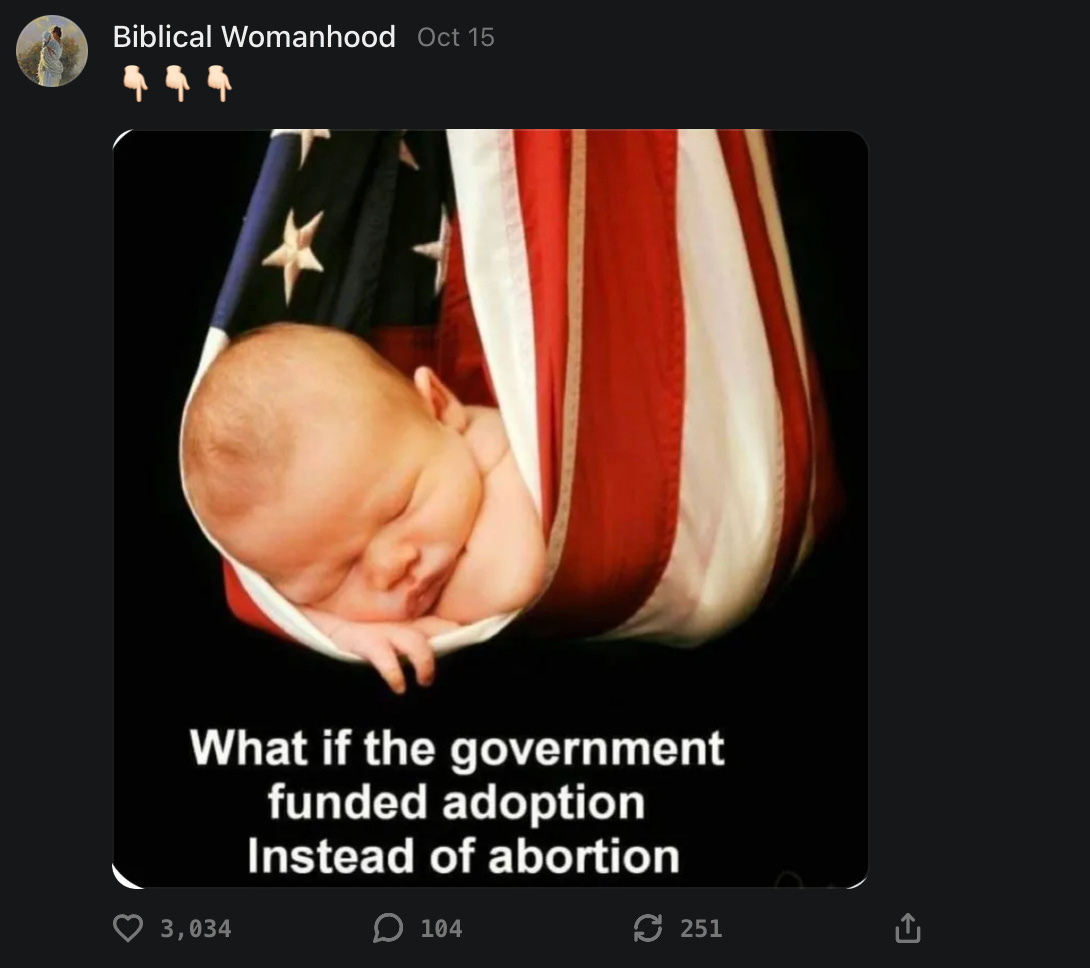
We go from standard right-wing viewpoints,
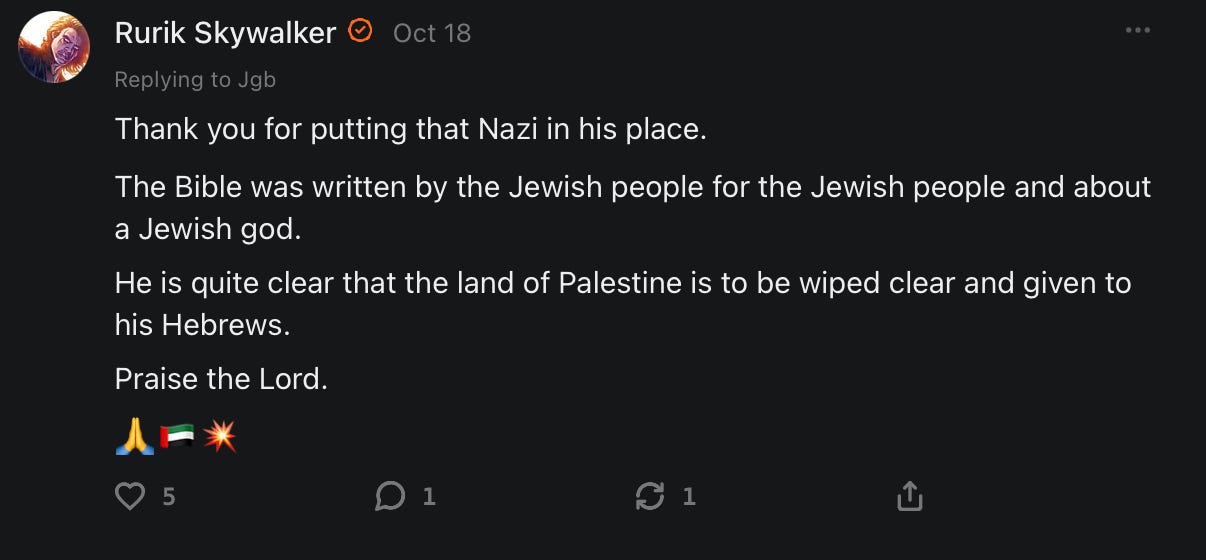
to religiously-based justifications for genocide,
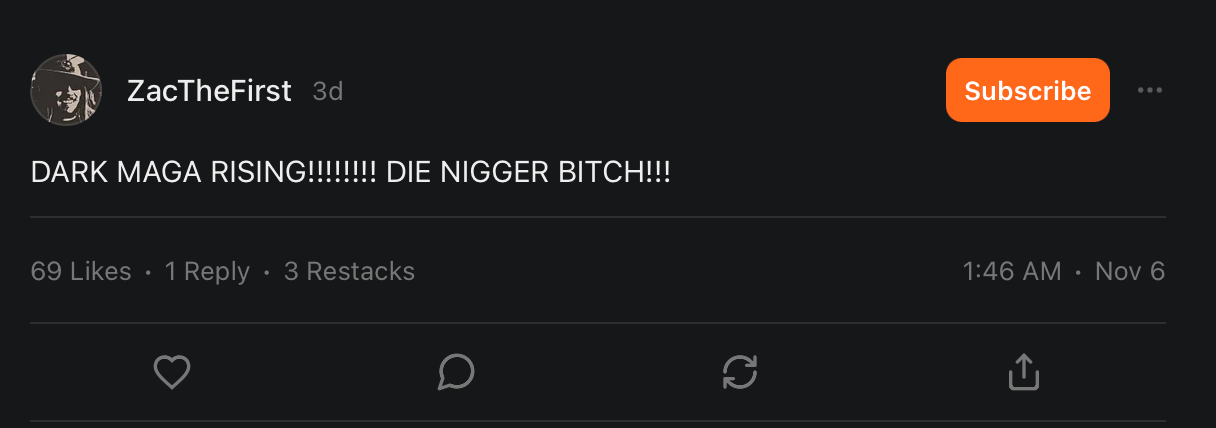
to people calling me the n-word. Real fast.
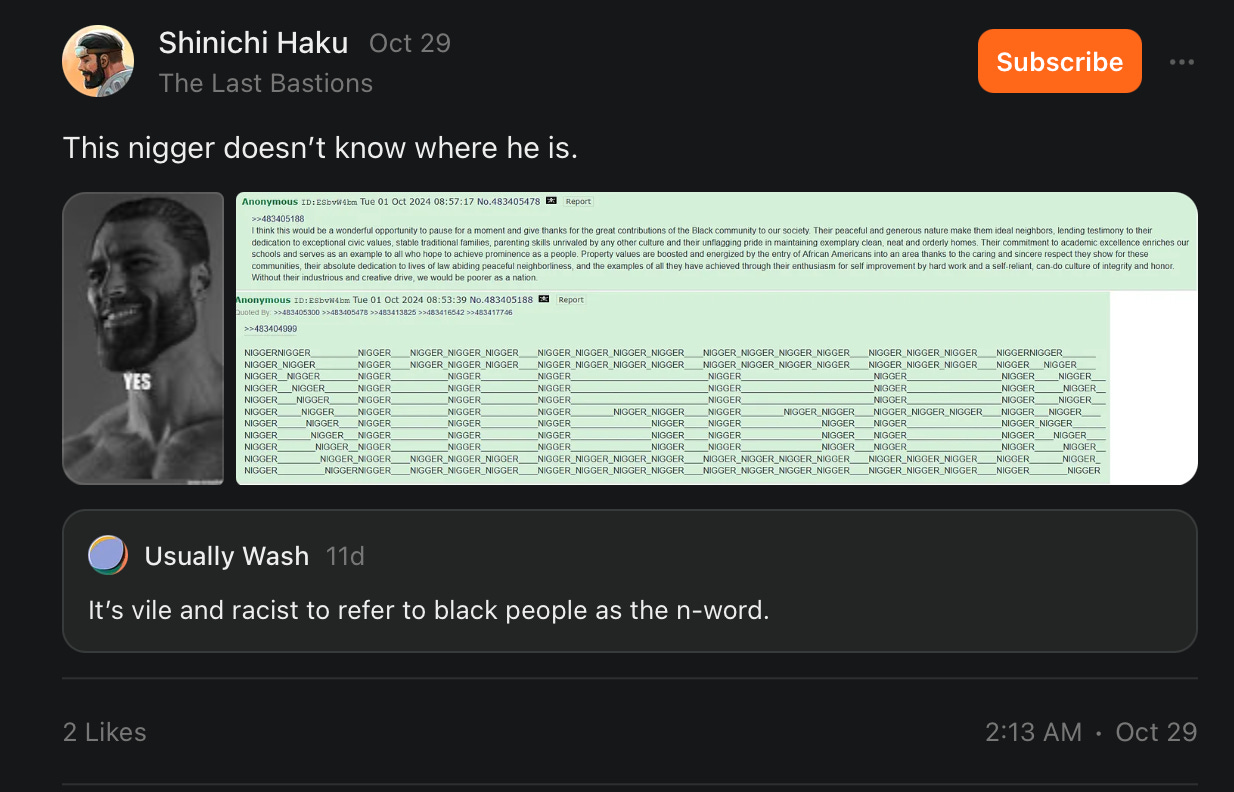
I can understand the policing of unsavory views has a myriad of consequences legally. Fine. My central question: how violent is this racial slur? What’s the measure of violence here? How is Substack discourse better for the use of it? How do we not see the use of this slur in this manner as something… other than an obvious precursor to physical violence? But, I’m ahead of myself.
In April of 2024, Chris Best was asked plainly if Substack policies would moderate content that could be considered extremist or harmful to marginalized people groups. The example he was given by the host of Decoder Podcast, Nilay Patel, was surrounding hate speech masquerading as political discourse. When pushed to answer the question directly, Chris said, “I’m not gonna get into ‘gotcha’ content moderation.” Direct quote. The whole painful clip is available here, but I’ll play/transcribe you a snippet.
Patel: I just wanna be clear— if somebody shows up on Substack and says, “All Brown people are animals and shouldn’t be allowed in America,” you’re gonna censor that.
Best: So we do have a terms of service that, that, you know, have narrowly perscribed, uh, you know, things that are not allowed. There’s— there are extreme cases, right? And I’m not gonna get into like, the—
Patel: Wait. Hold on. In America in 2023, that is not so extreme. Right? “We should not allow as many brown people in the country?” Not so extreme. Do you allow that on Substack? Would you allow that on Substack Notes?
Best: I think the, like— the way we think about this is that we wanna put the writers and the readers in charge—
Patel: No, I, I really want you to answer that question.
Best: I’m not gonna get into ‘gotcha’ content moderation questions.
Patel: This is not a ‘gotcha.’ I’m a Brown person! Do you think people on Substack should say I should get kicked out of the country?
Best: I’m not gonna engage in, you know, content moderation, ‘would you or won’t you,’ ‘this or that,’ content moderation questions.

By this time, Substack had already been featured by major news outlets like The Atlantic on their growing ‘Nazi Problem,’ swastika included. NY Times covered it too. If you want more sources, they’re listed in the open letter from writers on Substack that awful press coverage inspired. Remember, that letter circulated in January of 2024 (just a few months prior to the podcast debacle). White supremacist fascism rises across the world and evidences its germinating roots on social media platforms; Substack has the same problem everywhere else does. The question is: why does Substack think this state’s individual rights policy will yield them better results in terms of creating user safety for its most marginalized users?
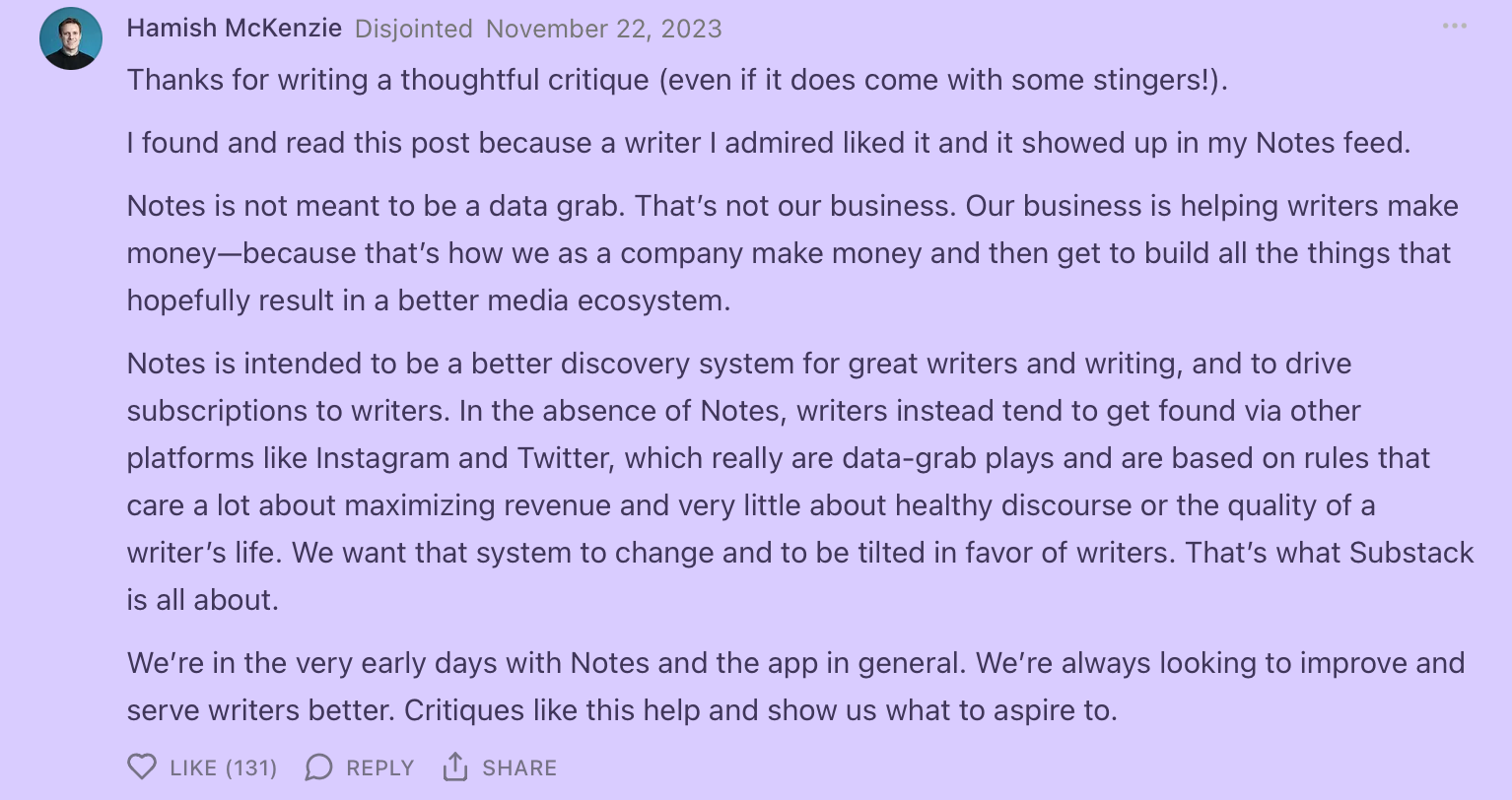
Hamish McKenzie (another co-founder of Substack) put out this message via the Substack “tweet” feature, saying… this. The message reiterates the talking points Chris tried and failed with in that interview: Substack is a new model where readers pay writers, which puts readers and writers “in charge” economically. As if that solves what I have deemed The N*gger Problem.
The N*gger Problem:
How do we (a profit-motivated social media publishing website) create feelings of cozy internet safety (emotions necessary to make writers feel secure enough to produce for us) while people spit racial slurs at them are on the other side of the wall? How do we take money from both sides without inciting mass exodus? How do we prioritize the production of company capital while failing to monetize writers that live in Africa, or in other parts of the non-Western world?
In other words: how do we, as a company, tell our user base that it’s okay with us if we you get called n*ggers, and it is okay with us pay you like n’*ggers (that is to say, not at all), without just saying that?
As for Substack’s response to the idea of ‘“gotcha” content moderation, this morsel from Seth Abramson really sums up how I feel about that, shortened for republishing below.
Chris didn’t answer the question he was asked to answer in that interview for the simple reason that Substack as a corporation (not as a group of individuals) is ambivalent on the subjects of racism, antisemitism, misogyny, Islamophobia, bigotry against the LGBTQIA+ community, ableism, ageism, and so on. Your plan is to try to corral the racists into a space they have all chosen to be in so that they only interact with other racists and the non-racists never encounter them at all.
Why not just say that?

You will not be able to keep the racists and misogynists (et al.) in their highly lucrative (to Substack) digital silos. They will escape and smear their feces all over the walls, all the while carrying banners reading FREE SPEECH. That they do not understand what that phrase means, or its history, or when and how it is applied appropriately according to its meaning and history is less of a problem here on Substack than it would be elsewhere because candidly neither do you or Chris.
You have been told repeatedly that you have no idea what you are talking about on these subjects and you have repeatedly framed attempted instruction by people who do—people who know the law, digital communications, cultural theory, and history—as offering up either emotionalized pap or (as you state outright here) mere pretense.
Good luck with that. Just never say you didn’t know better.
and : I want you to understand that I could fill the rest of this email with screenshots of Substack users throwing this particular slur around alone. Racial slurs aren’t even protected under the United States Constitutionally-defined understandings of free speech. Why are they alright here? Why are writers on the African continent still unable to monetize their publications, but people calling me n*gger are? What the fuck? Putting power back in the hands of writers and readers… means the power to call me slurs? How am I empowered here? This is not rhetorical. Answer me.
For everyone else reading: I keep seeing, on my algorithmically-curated side of this place, sentiments like Substack is better somehow, more ours, than other social medias. Specifically that Substack is “friendlier.” Substack is not “friendlier,” nor is it solely a DIY publishing platform. Substack designers began early on in their social media fusion to polarize the audience so that they (hopefully) never touch, allowing them to maximize profits— which is so obvious that it actually feels insulting when the founders say anything else. I would have respected you all more if you had just said, “Everybody’s money is green to us!” rather than the corporate tap dancing you actually did do. That was so cowardly. I really don’t expect anything different from white capitalists but… my dude. We aren’t daft. I would @ Jairaj if I could, too.
I’ll expand on actionable conclusions at the end of this essay. For now, I want it in writing: you can either do something new or be a capitalist. You people have chosen the latter; I wish you would say that with your chest. The hate rhetoric is only going to accelerate with the addition of short-form engagement, like the tweet function and the ability to share short-form video. As Casey Newton of Platformer News said: This was the moment where I started to think Platformer would need to leave Substack. I’m not aware of any major US consumer internet platform that does not explicitly ban praise for Nazi hate speech, much less one that welcomes them to set up shop and start selling subscriptions.
But suddenly, here we were.
Ooh, speaking of which—
Ways Substack makes me :(
The Elite Capture of Substack (written by )
Here’s an essay that I feel engages the platform honestly. Cydney, you did that (and in such a lovely lilac). Hayes goes through the parts of Substack that feel quite icky: from the opportunistic launch of Twitter on Substack, to reformatting the homepage to the infinite scroll, to Hayes’s residency on Substack feeling like they came to the goldrush a tinge too late. How they mourn what Substack was like before the yelling and screaming bits that come with the tweet function, and how those that dissent to the proliferation of addictive, short morsels will inevitably be drowned out by those who use the feature well. How sad it is that we’ll all be compelled to scroll through Notes endlessly instead of reading more essays. Hayes also touches on how algorithms inspire us to perform for what this platform measures as success, which fails to promote a writer’s most individual, salient work.
I love how they note that Substack used the opportunity of Elon Musk purchasing Twitter as a strategic launching point, as well as the much needed roast of the fine art marketing with colorful tweets plastered all over it (lol). I especially love the comments of one of the founders, Haymitch, who argues that sincerely the intent of Twitter 2.0 is not to siphon data like the big bad legacy social medias.
Data collection and formation is the most profitable capital available in the human labor market, bar none. We know that using any “free” social media means that the data is the capital we pay to play. We know that by now.
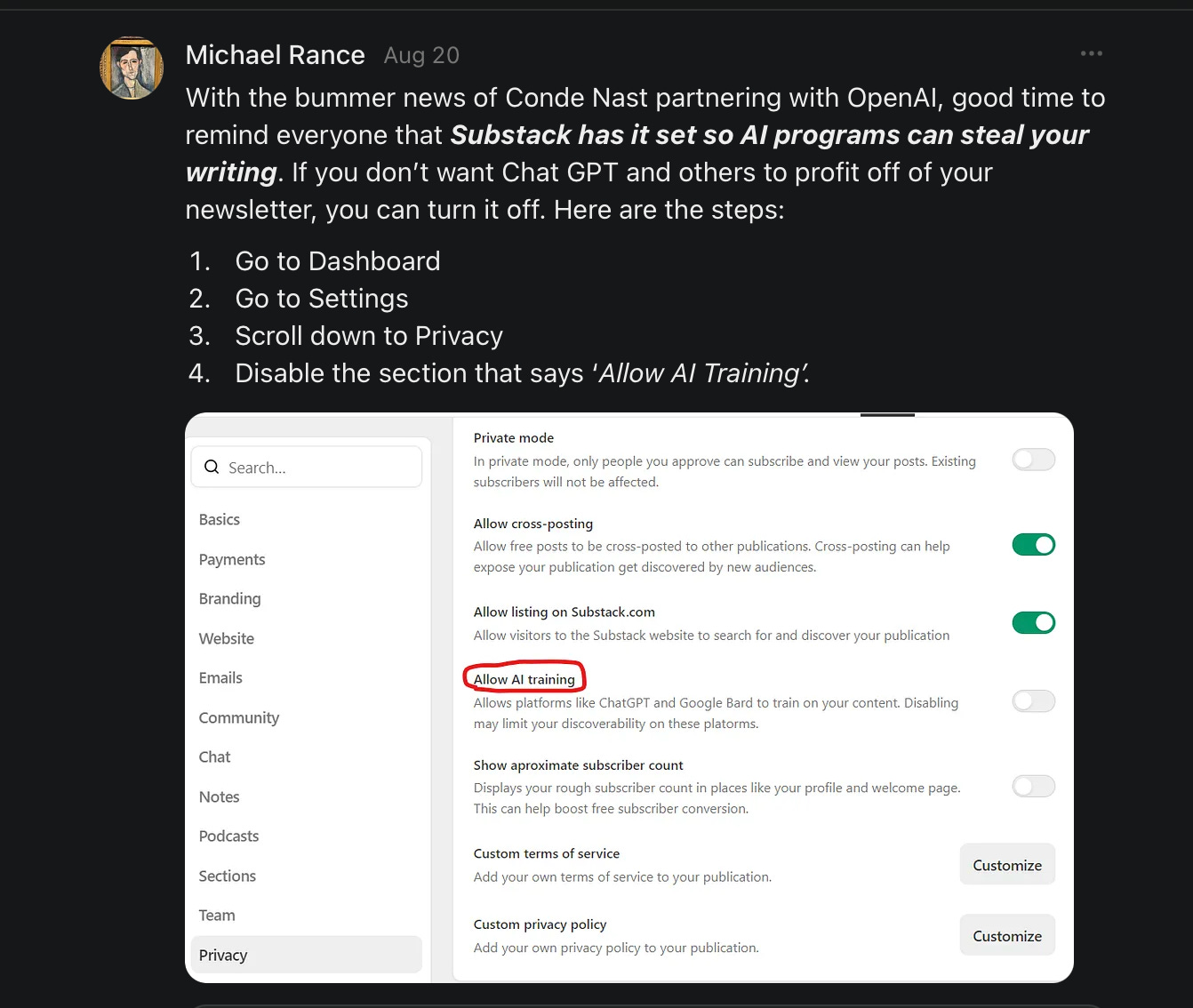
Thinking In Systems by Donnella Meadows has really bolstered my critical analysis skillset. She argues that the purpose of a system is not defined by its stated intent, but the products of that system. The founders and developers of Substack can intend all they wish for new, innovative online community and economies. They have made a new social media platform where the primary way to make money is in paid subscriptions and data, which isn’t really new at all. And they are collecting quite a bit of it— especially now that you are primed to share data in short, easy, quick to send thought nibbles. If the point were publishing and not data: why does the writing you do on Substack train Artificial Intelligence by default? This is not better than or friendlier Twitter, it’s just less populated and pre-programmed to polarize the user base.
The Unfortunate (yet Fiscally Necessary) Addition of Twitter
Every time I open Substack and am (sadly) greeted by a Twitter-like feed, I see a short thought that resembles something akin to the below at least once.
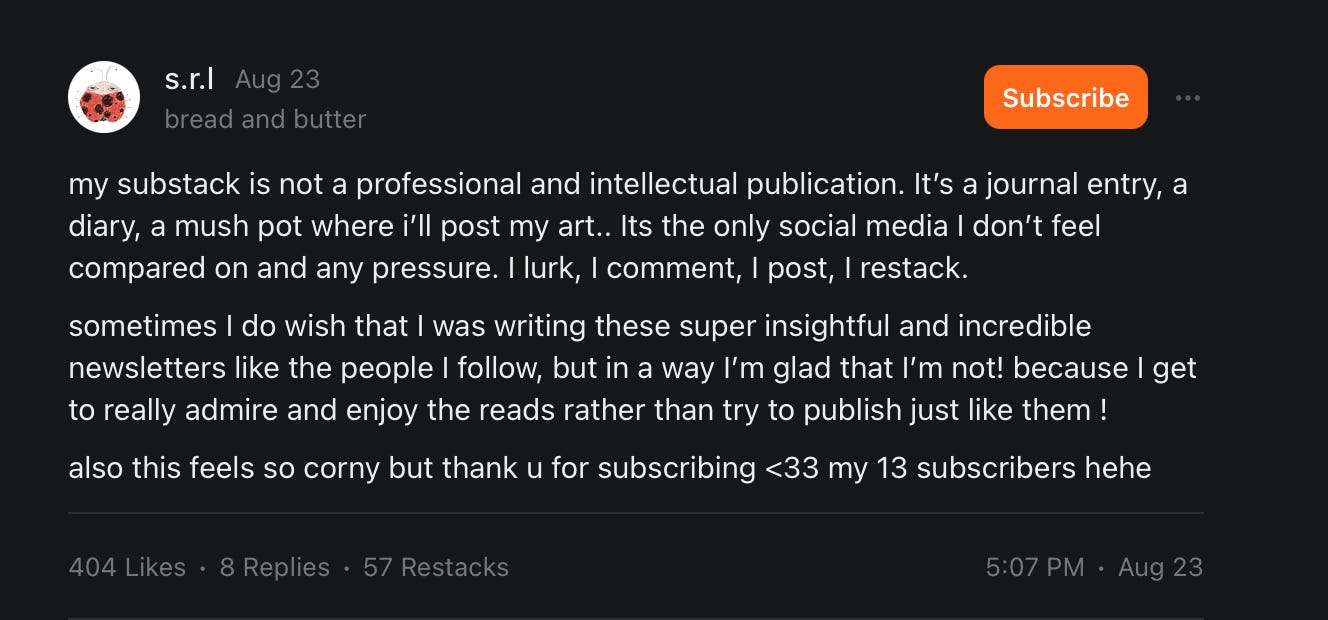
The above tweet (I’m not calling them Notes.) clearly resonates in the Substack cyberspace— 404 likes on Substack is, like, a lot right now. I enjoy that user s.r.l stated openly that Substack is a social media, because the branding— this “new economic engine for the culture”— leans into murky, intention-led marketing to obscure what makers and designers of this social media are and are not willing to say. As I see it: strong online community fosters habitual engagement. Habitual engagement, bolstered by parasocial relationships and algorithmic infinite scroll, result in people willing to spend money in order to maintain or increase these online places of intimacy. That’s not to say the intimacy, camaraderie, or friendship of internet connections isn’t real; that’s simply to say that Substack’s founders would really super love to profit monetarily from those interactions. Which does (unfortunately) mean that it makes fiscal sense to drive up eyeballs-on-screen time by adding that oh-so-lucrative infinite scroll. And lucrative it is— an in-house network that constantly interacts with each other allows Substack to make way more money. They said it themselves.
Back when Substack was exclusively an online mailbox for writers I enjoyed, it felt easy for me to spend pre-allotted time. There’s only so many long-form posts people can crank out in a week. I open; I digest; I pontificate; I close. With the addition of short-form, bite-sized thoughts (tweets, status updates, stories etc.), suddenly this thought-sharing becomes instantaneous.
Especially in the addition of quick tweets, we have the ability to make people think and feel in the short-form. I do not like what that does to my brain. Because I experience media consumption as intensely intimate, I’ve become deeply careful and cautious of what I ingest. For however long I let those morsels sit in my consciousness, it becomes a part of me— just like the process of digesting food, how bits and pieces eventually end up in your body, not just among it. I am even more careful now about the media that I produce, because I have never been more aware of how easy it is to make someone feel something. Maybe I am not supposed to say that in writing. Part of the allure of following people is that you sincerely feel like they are like you, or at least like you enough such that if you had met at a bookstore/ coffee shop/ other places of commerce where we in the Western/ized world fantasize about love and connection, you all could manage to become friends. Ah. As an “influencer,” as a person with power: it alarms me how easy it is to make someone reading, listening to, or watching me feel something. That’s what all great artists do. They inject you with emotion. I don’t like all the micro-injections of Twitter, on any platform, ever. It aggravates the stress not in my back. Very good for building cult-followings, though.
Substack is a place of commerce that we are pretending is for socializing and artistry. I refrain from ascribing a value judgement to that in particular. I enjoy coffee shops and bookstores as sites of potential connection, I find commerce to be morally neutral. I have two hang-ups: (1) Lying to ourselves about the intention of the infrastructure we engage with becomes dangerous. Substack is not the “friendlier” version of Twitter, it’s just not as saturated yet and is highly segregated. Substack doesn’t make a lot of money making you angry (yet), so it won’t. (2) The emphasis on followers and money placed here by the world-makers means that we, the participants, ascribe more power to those more visible and those paid. Which limits the stage to the Western world. Substack founders self-describe as capitalists so like… eh. They’re not doing anything different than other social media sites. But that’s the point of this section, isn’t it? They’re not doing anything different than other social media sites. As I said, lying to yourself is dangerous. I wish to be careful; I wish to be kind; I wish to be cognizant of the fact that the vehicle of the art changes the art itself.
It’s also a place of commerce that makes too much profit from white supremacists calling me slurs. Like. You can keep it.
Performing for the Almighty Algorithm
Then, there was this piece from Feed Me, written by — the tone of which made me roll my eyes and giggle at once. Two of the primary theses: (1) writing for Substack does not automatically create writing skills transferable outside this particular app, and (2) many people use Substack as a means to monetize their personal journals. In my opinion, Sundberg fleshes out what Hayes fears in passing: the desire to perform algorithmically produces copycat, lackluster work. See below:
Today, I can barely tell anyone apart. Many of the Substacks I follow use these big, figurative words that don’t really make sense in an attempt to go viral, which on this platform means getting subscribers and notes and comments. It’s like there’s this internet language that “works” for engagement (literal language, but also sense of style, and a range of trending topics to touch upon) but it all coagulates together and creates a whitewashed, boring internet. A friend pointed out that even these peoples’ bad days look the same — it’s never “I thought about killing my boss,” or “My group dinner the other night made me super anxious but I posted it on Instagram anyway,” it's always like, “wallowing, languishing, reading by the lake, journaling, feeling blue by the window.” —Sundberg, 2024. Read it for free here.
The above analysis, at least, holds veracity— and the essay itself? Brilliantly written. Thoroughly enjoyed. I am also very willing to say that Sundberg had…valid critiques of the quality of writing spurred on by a social media algorithm, despite how much this ruffled from feathers. The shape of Substack encourages users to write along algorithmic-backed trends in pursuit of social media metrics of success— likes and views that convert to visibility, and visibility which (hopefully) converts to paid subscribers. Algorithmic success, unfortunately or fortunately, encourages sameness. Later in the essay, Sundberg cites a collaborator she pitched the above essay to. She quotes his email response to her: “Monetized diary entries is totally right. I cringe when I hit a paywall on some random weekend update newsletter of a writer who I subscribed to because their work was interesting. Like you want me to pay for 5 links you read this week or your fav new novel?”
Valid! And: I would add that this phenomenon occurs across all social media— from the desire to have economic stability, there bursts forth the willingness to package and sell your own life. Welcome to capitalism! With just a touch of marketing, you too can join the petit bourgeoisie at the low, low cost of every morsel of sincere human connection you come across in a day packaged like a Twinkie into a filtered, consumable format. Those adept to videography gravitated to YouTube; those that put together aesthetics well thrive on Pinterest and Instagram; the terminally witty had Twitter (RIP); the long-form writers now have Substack. Across social media platforms, we have come to expect a varied amount of quality from the output of its user base because some folks use as professionals and some folks simply share about their lives. And some do both! So like… did we/ do we have this smoke for, say, 2007 YouTube? People are just monetizing their lives via vlogging!! Oh my goodne— somebody call the church!!
You see how you sound? You don’t hear that? Okay. So, “monetized diaries” is a critique that stands without much moral impetus, or even specificity to Substack. But it did make me laugh! Thank you for the giggles! We’re coming back to this essay.
Am I writing like a n-word?
To expand, though, on the very valid points: social media incentivizes copycat material. Beyond prolific, or original, or thought-provoking— we are primed for praise. talks about this in their essay, Am I writing like a white woman? in which this college student considers why the top writers of any given genre on Substack are, more than most of the time, white. Yum brilliantly situates this within her own changing yearnings for whiteness, or white-adjecentness, or maybe the desire to be lauded and styled and praised like a skinny blonde white woman (as I said: we are primed for praise). Substack’s algorithm did not come from no where; none of the current social media algorithms we have exist in some magic silo, where race and class and Beauty capital and bodies are negligible points. Of course we know, but the essay is a good reminder written by a college student with a sharp pen. Well done, Yum.
I mention this essay here because it, along with the author’s lived experience, was the base essay for the essay, Am I writing like an n-word? by . This author recalls a job they held six years ago, where they were writing white as a Black copy editor. The job becomes too stressful to tenure when Ricketts’s racial identity rubs up against how much of a professional necessity it is to ignore the fact that they’re actually Black all the time, not just when they are off the clock.
I thanked her in advance for paying me late. But I could write white, and I had to because the job wasn’t about skills. It was about not scaring Doria with n-word feelings and n-word thoughts.
To spoil the end of that (perfect, poignant) essay: she’d been playing my n-word game all along.
That was the ultimate insult to both of our experiences. I hadn’t been writing white. I was merely surviving. She hadn’t been cowering in her n-word fears. She’d been calling me out of my name loud and clear. With the low wage. With the late payments. With the lip service.
This is how I feel about Substack. That we know how we’re being treated, how we’re expected to perform.
This means that Substack users, not just the platform makers and operators, two have a n-word conundrum:
How do we contend with writing to save ourselves on this platform that refuses to moderate hate speech, which of course, we know, is violent in and of itself? This same platform “cannot seem to” find work arounds to paying African writers and anyone outside Stripe’s current operating countries. We know we’re vulnerable; we know that traditional publishing locks us out. How do we go about utilizing this space to our maximum benefit? This is not rhetorical. I would love to see us work this conundrum out in the comments.
The Exclusion of African Voices on Substack
Ever since I found out that African and non-Western Substack users can’t get paid, I’ve had a bad taste in my mouth. Substack will fault the payment processor— Stripe isn’t active within those countries— and I will still feel a need to go and brush my teeth. You have the anti-Blackness baked in. Subscribers that illicit paid subscriptions are so valuable to you, you include them in the badge system on your website. You do not set up infrastructure that allows Black (and other marginalized) creators to be paid. I do not care about the intent. What is the output of a system like that?
The (Unfortunate) Influencer Costume
Where there is commerce, there comes hierarchy. This is the first social network I have seen create color-coded badge system, indicating who is making the most money via paid subscriptions and I just... I just. Ew. God, that’s gross. I don’t always (or really ever) want to be an influencer, I want to be a writer. Social media is the shape of the column I write for, so I become what I need to for the life I want. And yet— I, too, am a system made and defined by my outputs, not my intents. It doesn’t matter whether I intend quality, intimacy, or connection via the written word. The result of me having a large following on this space, bringing in my large followings from other parts of the internet, determine a fair amount of my function as an influencer here, too.
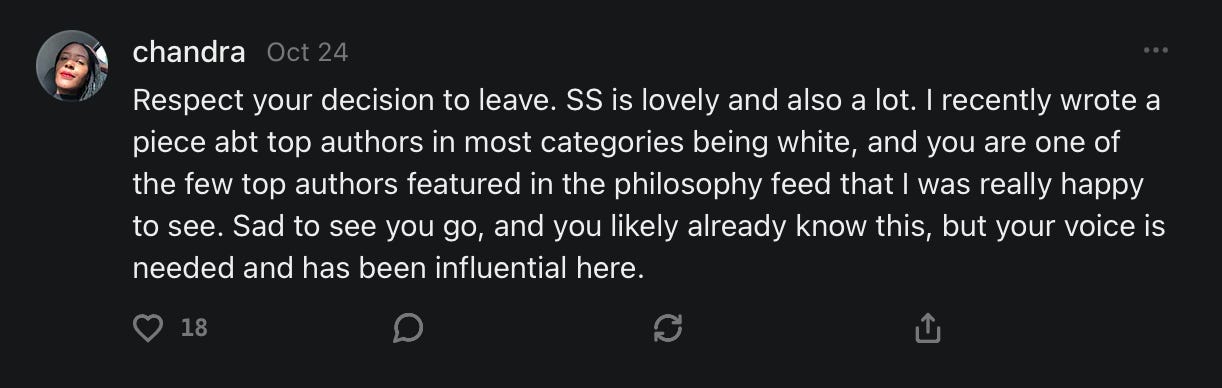
Addendum to add… I am very partial to you all who manage to love me through an ethernet connection. Conclusions are looking grim, but this comment stopped me in my tracks.
I’m also finding that my problem is that I like academics. I like disciplined, layered intellectualism. I like concentrated time and effort in interdisciplinary study. If I didn’t have so much beef with the academy, I would heavily consider becoming a professor. As much as I enjoy making my studies in revolutionary theory and history bite-sized… I am also a student and a writer trained in elite Western universities. Like I said, it’s not healthy to lie to oneself! And I (me, ismatu) like a lot of pomp and circumstance. I like rigor and difficulty, as it makes me feel ~noble~ for having studied. I like readings that I have to work for and writings that I have to turn in my mouth over and over again to comprehend the specificities and implications of what I’m arguing. I like it when the bar is high enough that my first draft could never, ever clear it.
No shade at all— that is not Substack! That’s not what the girls are here for! We want to read each other’s journals and I think that is cute and fun! I like that style of writing; I’m simply realizing this can’t be the only space that I write for public consumption. A thesis bubbles up here: you can only have so many conversations in public forum spaces. Eventually, you need concentrated, offline focus— or otherwise, your thoughts move like a pinball within the bounds of what you actually cannot say to masses of strangers. For discussions on revolutionary organizing, I am bound before the topic of armed struggle and strategy. For studying in public, I can only go as fast as people can read. Because I have committed to teaching and radical public education, I don’t think the solution here is just to write what I want with no regard for my constituency, or to quit entirely. The trust you all place in me to teach motivates me daily. I am also realizing a need I have: the pomp and circumstance of grappling with academic writing and reading at my own pace.
Shape Determines Function
Back to that essay from Feed Me— this is where I feel like the author has a veneer of elitism.
Because… girl.1 People write for the shape of the column they attempt to fill. Magazine writers do not sound like copy-editors, who have separate and distinct tones from newspaper journalists or personal essayists. The same poet who disseminates their work via Pinterest and via the LA Review has different tones from the same pen. The shape of the vehicle determines the function of the work. I am responding to you as someone who, like you, has a writing degree from an elite program. To paraphrase the argument: oh, so everyone is a writer now? …Yeah g. A writer is someone who writes.2 If that threatens you… step your pussy up**? Idk.
**Additionally… where is the paragraph in this essay where you situate yourself within the critique? Writing an essay with one of the theses being, “Succeeding at Substack does not mean you can succeed everywhere,” while succeeding at Substack such that you do it full time…? And there’s… no moment of digress, no self-reflection about that dynamic of contradiction? Are you not shaping yourself for this column? Girl. Come on! It does just feeeeeel like that we don’t like it when literary success is not as exclusive or prestigious as traditionally institutionalized media necessitates, and that… is such a WASP-y heart palpitation to have. Which, to be fair: you did straight up say, in your subtitle, “Substack is encroaching on what was a once a respectably literate walled garden.” Didn’t y’all already have this crisis? Happened with film. Happened with photographic media. Happened with music. Now here we are, witnessing innovating within publishing (at whatever cost to our personal data). But I guess your Substack merits count because yours has been heralded as Good™ in, like, actual magazines. Or something.
Since we’re throwing stones a bit! All in good fun! Haha. Anyways.
Reasons I do like Substack! :)
the Merit of first-draft thoughts
I also like it when I have a long, sprawling records of my first draft thoughts. For me: Substack functions as a means of public archival, where the stakes are low enough such that I don’t beat myself up over a typo or clunky wording. Substack is the place where I come to unfold with perception, especially as a young revolutionist. Two years ago, I would have balked saying something like that. The trajectory of my life is clear to me now. It is not useful to lie to yourself. While there’s psychological safety in believing myself insignificant, sometimes I let that spiral into the false belief that I cannot and do not make a difference. I am doing a lot of things that matter to folks I know and ones I do not, and most especially things that matter to me. To my babies! I want to document the processes of these actions, especially considering that I am only going to be here until medical school. We have about… three-ish more years to enjoy my presence social media as I currently inhabit it. And then I am done (!!!). So a space where I am unfolding and becoming is, then, important. Both to keep my blueprints and to make sure I share and show my work in regards to: grassroots farming, disciplined study, community-funded public health initiatives, and growing up in public. What it means to make and re-make our understandings of Human.
Journal reading is fun! damn!
I’m not a yum-yucker! “Substack lowered the garden wall and now everyone is playing” okay. Word. One time for the literary segregationists. In the meanwhile: tell me about your life. Tell me about your day. Tell me about the micro-lessons you learned observing the world on your walk home from the train. I like that Substack (in its long-form glory) encourages people to look for things to notice. I think, so long as we are not sharing too much about our lives (internet safety!), this is a net-positive. I like that Substack has brought me and a lot of other people back to writing for the hell of it rather than for the elitism that we are taught from young ages to covet (we, here, being the Western world that I grew up in).
That’s it! These two things are worth it for me to continue here in the long-form. I will not be partaking in the Twitter feature! I tried it and it made my tummy hurt. This unfortunately does make it harder to read great essays, so I do invite you to utilize the comment feature below to share ones you absolutely loved.
Actionable conclusions:
Threadings. is leaving Substack.
Threadings. and its essays (well-researched, quasi-academic writings about world-making) is leaving Substack. You can subscribe here! I automatically subscribed the top Threadings. readers (those that open and read 50% or more of my published essays) because clearly y’all are locked in.
I have put forth an Artist Statement.
I read Neema Githere Siphone’s artist statement (viewable here) and said, “oh. Obviously I have to step my game up.” I think one of the most important things about the trust that you all give me in platforming my work is that I am honest with you about where my sincere personhood ends and where performance begins. I wrote about this in this essay called Shape Determines Function // the exoskeleton. It’s an essay that has eaten away at me all summer (and all fall, apparently. Did you know it’s December?). You can read that essay here, at Threadings.’ new homeplace.
Ismatu Gwendolyn is also leaving Substack.
Yes, another rebra— *boos from the live studio audience* okay damn! Wait!! While I don’t like Substack anymore, I do like that it made me want to write outside of academic, prim and proper pointe shoes. I don’t like attaching likes to my work, so behold: First Draft Visionary. The posts here are going to be far less essay and far more journal entry with sources. The process of thinking in public will most definitely continue, but there’s a lot of small life I want to write about that doesn’t have some big, PBS special lesson at the bottom of it. My daily life convinces me that tomorrow is worth working for. I learned how to grow blue corn this summer. I watched Abbott Elementary with my mom tonight. A line artist in Amsterdam taught me about printmaking last year. All beautiful essay titles where I fall briefly in love with this world once more; I am excited to write to you about it.
I’m turning off paid subscriptions on Substack (obviously).
“ismatu is that not… nuts? Doesn’t this money go towards developing farming in Sierra Leone?”
Yes! It does!! The life of mine that you don’t see has me wading through upline swamplands, sitting down with tribal elders in a gown and foam slides to bring forth next year’s rice harvest. The money from Threadings. does that! We are growing rice in Sierra Leone! I would be lying to say I was not moderately frightened of what I am saying to you right now, especially because there is no guarantee people who are paying will follow me. But I also will be damned. I will be damned to make this place more money. My birthplace is a thing of happenstance; I am a New Afrikan through and through. I have brought Substack over 30,000 users on my own, from other social media platforms. So… you mean to tell me I’m packin the club and they’re letting in every slur-slingin’ two buck chuck come in because of some “writers are in charge” cockamamie nonsense? And writers on the continent of Africa still cannot get paid? Goodbye. If I’m in a position to make an exit loud enough to enact some policy change, then I should.
Please, if you feel so led, continue to pay for Threadings. here. I have really enjoyed creating a public good. You can do so here.
That’s all! I’ve re-routed some of my favorite essays. Everything else will live here as an archive. For now. And if you are a podcast listener, absolutely nothing is changing for you!!
I hope the work of your day passes through your hands with ease.
ismatu g.